
About the Abortion Pill
The Abortion Pill (also called Mifeprex, Mifepristone, or RU-486) provides women with a medical alternative to surgical abortion.
We accept most PPO / HMO Insurances.
Our Locations
312-707-8988
659 W. Washington Blvd.
Chicago IL 60661
Fax (312) 707-9223
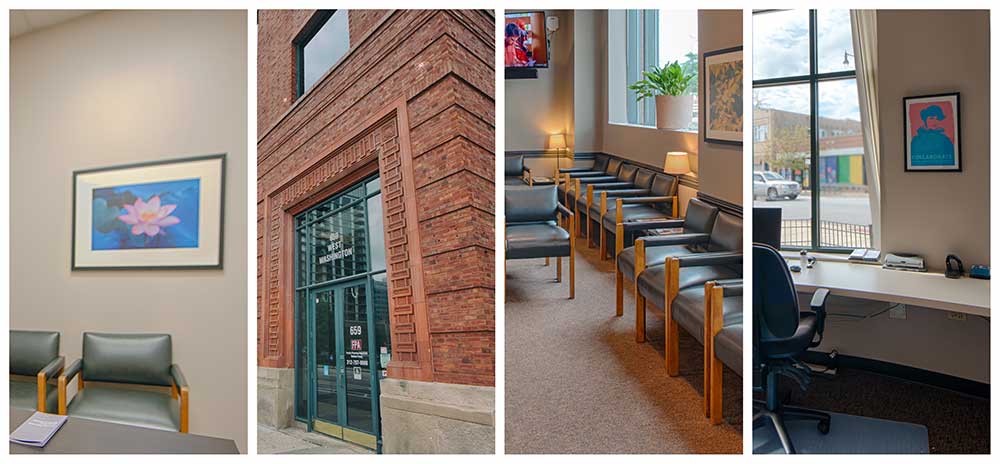
Plan to spend 1 to 2 hours with us in the office.
When you arrive at the office, you will be asked to complete personal demographic and health information and consent forms. A lab technician will draw a sample of your blood to determine your Rh factor and iron level. Your vital signs will be taken. The clinician (a Physician Assistant or Nurse Practitioner) will review your medical history and perform a physical examination and transvaginal (internal) ultrasound. An admissions staff member will explain the procedure to you and assist you in completing additional paperwork.
Taking the First Pill (Mifepristone)
You will take the first pill, mifepristone, in the clinic.
Day 2: Take Misoprostol at Home
We will give you a time frame in which to take the second dose of misoprostol.
Plan to be at home for at least 12 hours after taking the second dose of misoprostol. Expect to have bleeding, blood clots and cramping
You will have your vital signs taken, a transvaginal (internal) ultrasound, and a physical exam and/or blood testing (if necessary). If you would like to start a birth control method, we can provide you with one at this time, if you are medically eligible.
The Abortion Pill procedure involves the oral ingestion of mifepristone after ultrasound verification of a pregnancy ten weeks gestation or less. 24 to 48 hours later, misoprostol is inserted into the cheeks, held in place for 30 minutes, and then swallowed with water. In most cases, a miscarriage occurs within 24 hours.
If bleeding does not occur after 24 hours, the misoprostol insertion is repeated or a surgical procedure can be performed if you prefer. Usually bleeding is like a spontaneous miscarriage and bleeding or spotting may occur for up to two weeks or longer. An ultrasound will be used to verify the successful termination of the pregnancy.
The abortion pill is limited to patients ten weeks pregnant or less, as verified by ultrasound. If the abortion does not occur with medication alone, a surgical abortion must be performed. This situation rarely occurs, but the patient must agree to undergo a surgical abortion if the abortion is not completed with the medication alone.
The primary advantage of the abortion pill lies in the ability to end the pregnancy in the privacy of the patient’s own home. Side effects of mifepristone and misoprostol can include nausea, vomiting, diarrhea, heavy vaginal bleeding, headache, dizziness, backache and fatigue. Occasionally, the cramping may become quite severe, particularly when the pregnancy tissue is being expelled.
No sexual intercourse, tampon use, or douching is allowed for two weeks after your abortion.
Mifepristone is as safe as a surgical abortion for most women. The medication abortion is a completely noninvasive procedure and does not require sedation or a local anesthetic. However, as with surgical abortion, risk of hemorrhage does exist. In rare cases, the incomplete passage of tissue requires a surgical evacuation.
Serious infection can occur in about 1 per 1,000 women and death from infection occurs in less than 1 per 100,000 women. Therefore, if you develop a flu-like condition including sluggishness, weakness or muscle aches with or without fever, abdominal pain, nausea, vomiting or diarrhea more than 24 hours after taking misoprostol (Cytotec), it is essential that you call us immediately.
As a means of helping to prevent the already low chance of infection, we will provide you with antibiotics. Please tell us if you have any drug allergies or have had any abnormal reactions to any medications. You can help prevent infection by taking your antibiotics as directed and by avoiding tampon use, sexual activity, douching, or placing anything in the vagina for two full weeks after the abortion pill process. Please contact us immediately if you have any signs of an allergic reaction or have other abnormal reactions to your medications during the abortion pill procedure.
Approximately 1.75 million women in the U.S. and millions more worldwide have chosen the Abortion Pill. It is effective approximately 92-95% of the time. This means, for every 100 woman who use the abortion pill between 5 and 8 women will need a surgical procedure to terminate the pregnancy or to stop heavy bleeding.
Misoprostol (or Cytotec) is a prostaglandin drug. It had previously received FDA approval for use in the prevention of ulcers in high-risk patients taking non-steroidal, anti-inflammatory drugs.
The abortion pill uses two medicines to cause a miscarriage and end a pregnancy. The medication abortion is a safe and effective way to end a pregnancy up to 13 weeks in the privacy of your home.
This is a non-invasive procedure that feels more natural for some people. You can be with a spouse, partner, family member or trusted friend, for support with the medical abortion, in the comfort of your own home. Patients who want a less invasive procedure prefer the medication abortion.
The first step involves an office visit, including an ultrasound, lab work and exam. Mifepristone ends the pregnancy. Pregnancies need a hormone called progesterone to grow and mifepristone stops your body from making this hormone.
Misoprostol helps your body pass the pregnancy and causes bleeding and strong cramping. 24-48 hours after your office visit you will take misoprostol, and you must stay home for 12-24 hours after taking this medication. During this time, you should rest until your bleeding and cramping is light.
A few days later, we will ask you to think about your body’s response to the medications and do a self-assessment. This assessment is a series of four questions about your experience. If you answer ‘NO’ to any of these questions, it is very important that you call us as soon as possible. You may need to return to the office to confirm that you are no longer pregnant.
Lastly, you will take a pregnancy test at home about five weeks later. We will give you a test to take home with you on your first visit in our office. If the test is negative, you will know the medication abortion worked, and you are no longer pregnant. If your pregnancy test is positive five weeks after the abortion, you may still be pregnant, or you may have become pregnant again. Call us immediately if this happens so we can schedule you for an office visit and additional treatment if needed.
The pain will be the worst after you take the second medication, the misoprostol, at home. Cramps similar to heavy period cramps are common, and for some people the cramping and pressure can be very severe.
We will give you pain medication to help reduce your discomfort.
If you want to feel less cramping, you can take one of the pain medications 30 minutes before taking the misoprostol. Take your pain medications on a regular schedule until your pain is gone or light. If you are not taking pain medication regularly, it will not help with your pain because it only works for 4-6 hours.
If you wait until you are in pain to take medications, you will be in pain longer, because the pain medication takes time to start working.
Do not use any aspirin medications like Bayer, Excedrin, BC, or Goody’s. These medications can cause heavier bleeding sometimes.
Milder cramps, like period cramps or less, may last for a few weeks after you pass the pregnancy.
You could have heavy bleeding and cramping and pass clots after taking the abortion pill but still be pregnant. Sometimes the pregnancy will keep growing after you take the abortion pill. Sometimes the pregnancy will end but not pass out of the body. If you do not have any bleeding within 24 hours of taking misoprostol at home, please call us. You know your body best, if you do not think the medication worked, call us so we can schedule you for a follow-up visit in our office.
3-4 days later, we will ask you to think about your body’s response to the medications and do a self-assessment. This assessment is a set of four questions about your experience. If you answer ‘NO’ to any of these questions, it is very important for you to call us. You may have to return to the office to make sure that you are no longer pregnant.
5 weeks later, you will take a pregnancy test at home. We will give you a test to take home with you when we give you your medications. If the test is negative, you will know the medication abortion worked, and you are no longer pregnant. If your pregnancy test is positive five weeks after the abortion, you may still be pregnant, your hormone levels may be falling slowly, or you may be pregnant again. Call us immediately if this happens so we can schedule you for an office visit and additional treatment if needed.
The medication abortion does not work 100% of the time. After you take the abortion pill, we will ask you to do a few things to make sure that you are no longer pregnant.
3-4 days after you take the medication, we will text you a reminder to think about your body’s response to the medications. This self-assessment is four questions about your experience. If you answer ‘NO’ to any of these questions, it is important that you call us as soon as possible. You may need to come back to our office to make sure that you are no longer pregnant.
You will also take a pregnancy test at home about five weeks later. We will give you a test to take home with you at your first visit when we give you the medications. If the test is negative, no more follow up is needed. If your pregnancy test is positive five weeks after the abortion, you may still be pregnant, your hormone levels may be going down slowly, or you may be pregnant again. Call us immediately if this happens so we can schedule you for an office visit and more treatment if needed.
If you are still pregnant after you take the abortion pill, you have two options usually. You can take more medicine sometimes or have an in-office abortion procedure at FPA as long as you are less than 24.0 weeks pregnant.
Occasionally, only some of the pregnancy tissue will pass. If this happens, you could have heavy bleeding, develop an infection, or both. An in-office suction procedure (D&C), more medications, more tests or treatments could help to prevent these complications.
Sometimes, clots in the uterus can cause cramping and pain in the belly and/or lower back. If this happens, you may need a suction procedure (D&C) or more medication to help pass the clots.
If the medication abortion does not work, you will not be asked to make any extra payments to FPA. You must return to our office if you think that you are still pregnant or if our staff ask you to come back because we think you may still be pregnant. If you need to go to another clinic or hospital to complete the abortion for medical reasons or because you are more than 24 weeks pregnant, you will be responsible for the cost of that care. For this reason, we encourage you to come back to our office as soon as possible if you have any concerns that the medication may not have worked.
If you know that it will be hard or impossible for you to come back to our office, the medication abortion may not be the best choice for you.
You can exercise the day after you take the second medication at home. Strenuous exercise can sometimes increase the amount of bleeding and cramping that you experience. You should not exercise if you feel like you have not passed the pregnancy.
After you exercise, if your bleeding and/or cramping increases, stop exercising. If this happens, you should be less active and do not exercise again until your bleeding has been light for 24 hours.
Please do not hesitate to contact us if you have any questions or concerns. If at any point you fully soak a maxi-pad in one hour or less, you should call us right away. A 24-hour on-call service is available after hours in case of an emergency.
Since 2020 more than half of abortions provided in the Unites States are done with medication instead of surgery. Approximately 1.75 million people in the U.S. and millions more worldwide have chosen the Abortion Pill to end a pregnancy. It is effective approximately 92-98% of the time. How well the medication works can depend on how far along you are in the pregnancy.
less than 7 weeks — Works about 98 out of 100 times the medication is taken
7 weeks — Works about 97 out of 100 times the medication is taken
8 weeks — Works about 95 out of 100 times the medication is taken
9 weeks — Works about 97 – 99 out of 100 times the medication is taken with two doses of misoprostol
10 weeks — Works about 97 – 98 out of 100 times the medication is taken with two doses of misoprostol
11 weeks — Works about 95 out of 100 times the medication is taken with two to three doses of misoprostol
13 weeks or more — Works about 92 out of 100 times the medication is taken with two to three doses of misoprostol
In person follow-up visits are rarely needed, but can be very important.
3-4 days after you take the medication, we will ask you to think about your body’s response to the medications and do a self-assessment. This assessment is a set of four questions about your experience. If you answer ‘NO’ to any of these questions, it is very important for you to call us. You may have to return to the office to make sure that you are no longer pregnant. You know your body best, if you do not think the medication worked, call us so we can schedule you for a follow-up visit.
5 weeks later, you will take a pregnancy test at home. We will give you a test to take home with you when we give you your medications. If the test is negative, you will know the medication abortion worked, and you are no longer pregnant. If your pregnancy test is positive five weeks after the abortion, you may still be pregnant, your hormone levels may be falling slowly, or you may be pregnant again. Call us immediately if this happens so we can schedule you for an office visit and additional treatment if needed.
If the medication abortion does not work, you will not be asked to make any extra payments to FPA. If you go to another clinic or hospital for evaluation or to complete the abortion, you will be responsible for the cost of that care. For this reason, we encourage you to come back to our office as soon as possible if you have any concerns that the medication may not have worked.
If you know that it will be hard or impossible for you to come back to our office, the medication abortion may not be the best choice for you.
Your bleeding will be heaviest after you take the misoprostol at home on the second day. Your bleeding will change throughout the abortion process.
Until the pregnancy passes, the bleeding will usually be heavier than your normal period. You may see blood clots and pregnancy tissue pass.
Once the pregnancy has passed, the bleeding will start to slow down. You may bleed or spot for 4 to 6 weeks after the abortion. The bleeding can stop and start again many times.
When your bleeding has been light for 24 hours, you can use a tampon instead of a pad.
You will take the first medication, mifepristone, in our office on ‘day one’ after having an exam, ultrasound, lab work and signing consents. You can go to work, school, or make other plans for the rest of that day. It is rare that you would start to bleed heavily or pass the pregnancy after taking the first medicine.
You should plan to be at home on ‘day two’ for at least 24 hours after taking the misoprostol (the second medication). Misoprostol helps your body pass the pregnancy by softening the cervix and causing the uterus to contract. You will have heavy bleeding, usually heavier than a period, and strong cramping. Because the bleeding and cramping is moderate to heavy for most women, you should not be at school or work while you are passing the pregnancy. In most cases you can return to work, school and your regular activities the next day.
Abortion Care Resources
You can complete your registration forms before you arrive. Simply download, print and fill out the forms.